DENTURE OPTIONS FOR MISSING TEETH
Dentures remain one of the most versatile ways to replace missing teeth because they can be designed for patients who are missing only a few teeth or an entire dental arch. Unlike some other tooth replacement treatments, dentures are removable and can often be customized without requiring surgery.
The appropriate type of denture depends primarily on how many natural teeth remain and whether those teeth are healthy enough to continue supporting the bite.
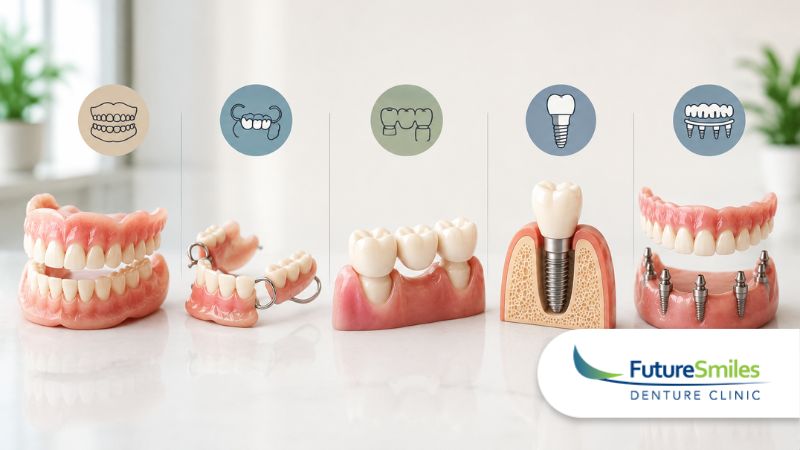
A partial denture is generally considered when some healthy natural teeth remain. The appliance fills the spaces created by missing teeth while working alongside the existing teeth. Depending on its design, a partial denture may use clasps or other components to help keep it stable.
Partial dentures can help:
- Fill multiple spaces in the smile
- Improve chewing function
- Restore visible missing teeth
- Support everyday speech
- Reduce unwanted movement of remaining teeth
- Provide a removable tooth replacement option
The health of the remaining teeth is an important consideration. If the teeth that would support a partial denture are severely damaged, loose, or expected to require extraction in the near future, another treatment plan may provide greater long-term value.
Full dentures, also known as complete dentures, are used when all natural teeth in an upper or lower arch are missing or need to be removed. They replace an entire row of teeth and also restore some of the facial support previously provided by natural teeth and surrounding tissues.
Modern full dentures are individually designed rather than being one-size-fits-all appliances. Impressions, bite measurements, tooth shape, tooth shade, facial proportions, and lip support are considered during fabrication.
Patients may require:
- An upper full denture
- A lower full denture
- Both upper and lower dentures
- Immediate dentures following extractions
- Conventional dentures after healing
- Implant-supported denture options
Immediate dentures are an option for some patients who need remaining teeth extracted. They are prepared before extraction and inserted shortly after the teeth are removed, allowing the patient to avoid an extended period without teeth.
Because the gums and jaw change considerably during healing, immediate dentures commonly require follow-up adjustments and relines. A longer-term treatment plan can then be developed once the tissues become more stable.
Traditional dentures can be a practical solution for patients who want to avoid surgery or are not candidates for implants. However, they require ongoing maintenance. The gums and jawbone naturally change after tooth loss, which means dentures may eventually require adjustments, relines, repairs, or replacement.
Choosing between partial and full dentures is therefore not simply about counting how many teeth are missing. The condition and long-term outlook of the remaining teeth should also be considered.
BRIDGES AND IMPLANT TOOTH REPLACEMENT
Dentures are not the only way to replace missing teeth. Depending on the number and location of missing teeth, dental bridges or dental implants may also be considered.
A traditional dental bridge replaces one or more missing teeth using neighbouring natural teeth for support. The teeth on either side of the space are prepared for crowns, and an artificial tooth or teeth are positioned between them.
Bridges are fixed in place, meaning patients do not remove them for daily cleaning. For someone missing a small number of teeth in a suitable area, this can provide a stable and natural-looking solution.
Potential advantages of a bridge include:
- Fixed rather than removable treatment
- Restored appearance
- Improved chewing in the affected area
- No implant surgery
- Relatively familiar daily function
However, neighbouring teeth generally need to be suitable for supporting the restoration. Preparing healthy teeth for crowns is also an important consideration when comparing a bridge with other options.
Dental implants take a different approach. An implant is surgically positioned in the jawbone and acts as a foundation for a replacement tooth. A single implant may be used to replace one missing tooth without relying on neighbouring natural teeth for support.
Implants can also be incorporated into treatment for multiple missing teeth. Depending on the situation, implants may support a bridge or provide attachment points for a denture.
Potential benefits of dental implants include:
- Independent support for replacement teeth
- Increased stability
- No removable appliance for certain treatments
- Support for implant-retained dentures
- Improved control of some full-arch restorations
Implant treatment is more involved than receiving a traditional removable denture. Patients require a detailed assessment, appropriate diagnostic imaging, surgical implant placement, and a period of healing before the final restoration can be completed.
Available jawbone is an important consideration because implants require adequate support. After natural teeth are lost, the jawbone gradually changes. The amount and quality of remaining bone can therefore influence whether implant treatment is possible and whether additional procedures need to be considered.
General health, oral health, hygiene habits, and the ability to heal following surgery are also evaluated before treatment.
For patients missing an entire arch, implant supported dentures can combine aspects of traditional dentures and implant dentistry. Implants are placed in the jaw and used as attachment points for the denture, providing additional retention.
This may be particularly useful for patients who struggle with movement of a conventional lower denture.
Implant supported dentures may provide:
- Greater denture stability
- Reduced movement during meals
- Less lifting while speaking or laughing
- Reduced reliance on adhesive
- Improved confidence in everyday activities
However, implant supported dentures are not maintenance free. The denture still requires appropriate cleaning and professional assessment, while the implants and surrounding tissues need careful oral hygiene.
Attachments can also wear over time and may require servicing. The denture itself may eventually require adjustments, repairs, or replacement.
Cost and treatment time are additional differences. Implant treatment generally requires a greater initial investment and longer treatment period than conventional removable dentures because surgical and restorative stages are involved.
Each of these factors should be considered when comparing implants, bridges, and removable dentures rather than focusing on one feature alone.
CHOOSING THE RIGHT REPLACEMENT OPTION
The best way to replace missing teeth is different for every patient. Someone missing a single tooth has very different needs from a person who has lost most or all of their natural teeth.
The first consideration is how many teeth need to be replaced.
A single missing tooth may potentially be restored with an implant or bridge. Several missing teeth may be treated with a partial denture, bridge, or implant-supported restoration. Complete tooth loss may require full dentures or an implant-supported full-arch solution.
The location of the missing teeth also matters. Front teeth have a significant influence on smile appearance and speech, while back teeth carry much of the pressure involved in chewing. Treatment planning needs to consider both appearance and function.
The condition of the remaining teeth is equally important. Keeping healthy natural teeth is generally desirable, but severely damaged or unstable teeth may complicate a treatment plan. A partial denture, for example, needs an appropriate foundation to function effectively.
When comparing options, consider:
- Teeth: How many natural teeth remain?
- Health: Are the remaining teeth and gums healthy?
- Bone: Is there adequate jawbone for implant treatment?
- Comfort: Are you comfortable with a removable appliance?
- Surgery: Are you willing and able to undergo implant placement?
- Time: How quickly do you need replacement teeth?
- Care: What maintenance are you comfortable performing?
- Budget: What treatment and future maintenance costs are manageable?
- Goals: What level of stability and function are you hoping to achieve?
Budget deserves careful consideration, but the lowest initial cost is not always the only factor that determines long-term value. Different treatments have different maintenance requirements and expected lifespans.
Traditional dentures may require periodic relines as the gums change. Partial dentures may need modification if additional natural teeth are lost. Bridges may eventually require restorative care. Implant components and implant-supported dentures also require ongoing professional maintenance.
Patients should understand these future requirements before making a decision.
Lifestyle can influence the choice as well. Some patients prefer removable dentures because they are straightforward to clean and do not require implant surgery. Others prioritize stability and are comfortable undergoing additional treatment to explore implant support.
There is also no reason to assume that the most technologically advanced option is automatically the best treatment. A well-designed conventional denture may provide excellent function for one patient, while another person may experience greater benefit from implant support.
If you already have missing teeth and are unsure what to do next, a professional assessment is the best starting point. The mouth, remaining teeth, gums, bite, existing restorations, and current dentures can all be evaluated before recommendations are made.
A personalized treatment plan can then compare the options that are actually appropriate for your situation rather than every possible tooth replacement treatment.
Replacing missing teeth is ultimately about restoring comfortable everyday function while creating a solution that you can realistically maintain. Understanding the advantages and limitations of dentures, bridges, and implants can help you choose treatment with greater confidence.
There are several effective ways to replace missing teeth, and the right solution depends on your individual oral health, number of missing teeth, lifestyle, treatment goals, and budget. Partial dentures, full dentures, bridges, dental implants, and implant-supported dentures each provide different advantages, which is why personalized treatment planning is so important.
At Future Smiles Denture Clinic, we can assess your current situation and help you understand the denture solutions available for replacing missing teeth. If you are unsure which option may be right for you, contact our team to schedule a consultation and take the first step toward restoring a comfortable, confident smile.
FAQs
Q: WHAT IS THE MOST AFFORDABLE WAY TO REPLACE MULTIPLE MISSING TEETH?
A: A removable partial or full denture may have a lower initial cost than many implant-based treatments, but the appropriate option depends on how many teeth are missing and the condition of the remaining teeth. Long-term maintenance and future treatment should also be considered when comparing costs.
Q: CAN I REPLACE ALL OF MY MISSING TEETH WITH DENTURES?
A: Yes. Full or complete dentures are specifically designed to replace an entire upper or lower arch of missing teeth. Depending on your oral health and preferences, conventional or implant supported denture options may be considered.
Q: HOW DO I KNOW WHICH TOOTH REPLACEMENT OPTION IS RIGHT FOR ME?
A: The best option depends on the number and location of missing teeth, health of your remaining teeth and gums, jawbone condition, budget, lifestyle, and whether you are comfortable with surgery or removable appliances. A professional assessment can help determine which treatments are appropriate for your needs.

.jpg "What Happens During Your Very First Visit to a Denturist?")