
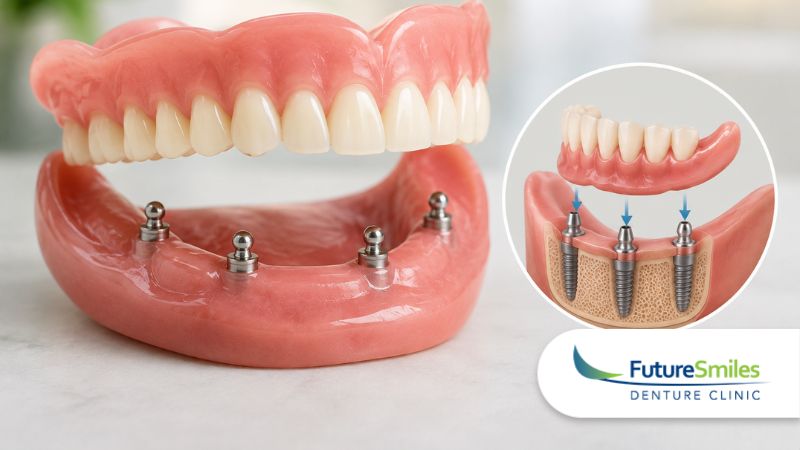
UNDERSTANDING IMPLANT DENTURES
Traditional full dentures are designed to replace an entire arch of missing teeth and rest directly on the gums. Their stability depends on the shape of the mouth, the fit of the denture, muscle control, and natural suction. A well-made conventional denture can restore important everyday functions, but some patients find that movement becomes a concern, particularly as the shape of their gums and jaw changes over time.
Implant-supported dentures offer another approach. Instead of relying entirely on the gums for support and retention, the denture connects to dental implants that have been surgically placed into the jawbone. These implants act as secure attachment points that can help keep the denture more stable during everyday activities.
Dental implants are small posts that are positioned within the jawbone. After placement, the implants are given time to heal and integrate with the surrounding bone. Once adequate healing has occurred, attachments can be used to connect the denture to the implants.
Depending on the treatment plan, implant-supported dentures may be removable or part of a more fixed restoration. Removable implant dentures are designed so the patient can take them out for cleaning. Other implant-supported restorations may remain in place and require professional removal when necessary.
The number of implants used varies according to the type of restoration, the condition of the jawbone, and the patient's individual treatment needs. There is no single implant configuration that is appropriate for everyone, which is why detailed planning is required before treatment begins.
One of the biggest differences patients may notice is improved stability. A conventional denture can sometimes move slightly during chewing, speaking, coughing, or laughing. Connecting a denture to implants can reduce this movement and create a more secure feeling.
Potential benefits can include:
- Greater stability while chewing
- Reduced movement when speaking
- Less reliance on denture adhesive
- Increased confidence while laughing or smiling
- Better control of the denture during meals
- A more secure feeling throughout the day
- Additional support for a lower denture
Lower dentures are often an area of particular concern because there is less surface area available for support and the tongue is constantly moving nearby. Some patients who are comfortable with their upper denture still experience significant movement with their lower denture. Implant support may provide another option when conventional approaches are not delivering the desired stability.
Implants may also help preserve bone in the areas where they are placed because they transfer forces into the jawbone. However, changes to the jaw and oral tissues can still occur, which means ongoing professional care remains important.
It is equally important to understand that implant-supported dentures are not maintenance free. The denture must still be cleaned properly, and the gums and areas around the implant attachments require careful hygiene. The denture itself may eventually experience normal wear, and attachment components may need servicing or replacement.
Patients should therefore think of implant support as a different way of stabilizing a denture rather than a permanent solution that will never require future attention.
BENEFITS AND THE TREATMENT PROCESS
One of the main reasons patients explore implant-supported dentures is stability. Loose dentures can make simple activities more difficult than they need to be. Eating at a restaurant, having a conversation, laughing with friends, or attending a family gathering can become stressful when someone is constantly thinking about whether their denture will move.
Implant support can help reduce that uncertainty.
Improved chewing stability is another potential advantage. A conventional denture rests on soft gum tissue, which means biting pressure is transferred through that tissue. Implant support can provide additional stability and help the denture resist movement while food is being chewed.
This does not mean patients can immediately eat anything without consideration. Denture wearers still need to use good judgement and allow themselves time to become comfortable with their restoration. However, improved stability can make eating feel more predictable for many patients.
Speech may also benefit from greater denture control. When a denture moves during conversation, it can cause clicking sounds or make certain words more difficult to pronounce. Reducing that movement may help patients feel more comfortable speaking naturally.
For people who rely heavily on denture adhesive, implant support may also reduce the need for adhesive. Increasing adhesive use is often a sign that a conventional denture should be professionally assessed. Depending on the cause, an adjustment, reline, replacement, or implant-supported option may be considered.
Some of the reasons patients explore implant-supported dentures include:
- Conventional dentures repeatedly becoming loose
- Difficulty eating certain foods comfortably
- Lower dentures lifting or shifting
- Frequent use of denture adhesive
- Concerns about dentures moving during conversations
- A desire for greater stability and confidence
- Difficulty adapting to conventional removable dentures
Receiving implant-supported dentures involves more stages than receiving conventional dentures. The process begins with a comprehensive assessment of the mouth and existing dentures. The gums, jawbone, bite, and overall oral health must be evaluated before determining whether implant treatment is appropriate.
Diagnostic imaging may be required to evaluate the jawbone and identify possible implant locations. The dental professionals involved in implant placement will consider factors such as available bone, important anatomical structures, oral health, and the planned final restoration.
If treatment is appropriate, the implants are surgically placed into predetermined positions within the jaw. The exact procedure depends on the individual treatment plan.
Healing is an important part of the process. The implants need time to integrate with the surrounding bone and develop the stability required to support the denture. Healing times vary, so patients should not expect every implant denture treatment to follow exactly the same timeline.
The overall process may involve:
- Initial denture consultation
- Assessment of oral tissues and existing dentures
- Diagnostic imaging
- Development of an implant treatment plan
- Surgical placement of the implants
- A period of healing
- Impressions of the mouth
- Bite measurements
- Denture design and fabrication
- Connection of the denture to the implants
- Final fit and bite adjustments
- Follow-up care and maintenance
Creating the denture itself requires careful attention to fit, bite, appearance, and function. Impressions record the shape of the mouth, while bite measurements help establish how the upper and lower teeth should meet. Tooth shape, size, colour, and arrangement can also be customized to complement the patient's appearance.
After the denture is connected to the implants, follow-up appointments remain important. Small adjustments may be required as the patient becomes accustomed to the new restoration.
The attachments that connect removable dentures to implants can also experience normal wear. If the denture begins feeling less secure after a period of use, the attachment components may need professional attention.
Daily cleaning is essential. Food and plaque can collect around implant attachments and beneath denture components, making consistent oral hygiene important for protecting the surrounding tissues.
Patients should follow the specific cleaning instructions provided for their restoration, which may include:
- Cleaning the denture every day
- Carefully cleaning around implant attachments
- Using recommended brushes or cleaning aids
- Removing a removable denture as instructed
- Avoiding damaging or abrasive cleaning products
- Attending regular professional assessments
Implant-supported dentures therefore require a long-term commitment to care. Their additional stability can be a major benefit, but maintaining the restoration and surrounding oral tissues is an ongoing responsibility.
WHO MAY QUALIFY FOR THESE DENTURE TYPES
Implant-supported dentures can provide significant benefits for the right patient, but not everyone automatically qualifies. Determining candidacy requires an assessment of oral health, general health, jawbone condition, treatment expectations, and the patient's ability to maintain the restoration.
One of the first considerations is the amount and quality of available jawbone. Dental implants need adequate bone around them to provide support. After natural teeth are lost, the jawbone gradually changes because it no longer receives the same stimulation that was provided by tooth roots.
The amount of bone loss varies significantly between patients. Someone who recently lost their teeth may have a different foundation than someone who has worn conventional dentures for decades.
Having experienced bone loss does not automatically mean implant treatment is impossible. Additional assessment can determine what options may be available. In some situations, other procedures may need to be discussed before implant placement can proceed.
General health is another consideration because implant placement involves surgery and healing. The dental professionals responsible for treatment will review relevant health information and determine whether there are factors that could affect the procedure or recovery.
Oral hygiene is equally important. Although implant-supported dentures replace missing teeth, the gums and tissues surrounding the implants still require daily care. Patients must be willing and able to clean around the implant components and follow professional maintenance recommendations.
Potential candidates may include people who:
- Are missing all or most teeth in an arch
- Currently wear full dentures
- Experience repeated problems with loose dentures
- Struggle with lower denture stability
- Want additional support while eating
- Have appropriate oral and general health
- Have suitable bone or appropriate treatment options
- Can maintain consistent oral hygiene
- Understand that implant placement involves surgery
- Are prepared for the healing process
- Can attend follow-up and maintenance appointments
- Have realistic expectations about treatment
Lifestyle and expectations should also be discussed. Some patients want a solution that feels more stable but still prefer the ability to remove their denture for cleaning. Others may be interested in exploring a more fixed option. Understanding these preferences helps the treatment team determine which approach may be most appropriate.
Cost is another important consideration. Implant-supported dentures generally involve a larger initial investment than conventional dentures because treatment includes surgical implant placement, implant components, planning, and the denture restoration itself.
Patients should also consider long-term maintenance costs. Attachment components can wear, dentures may eventually need repair or replacement, and professional maintenance remains necessary. Understanding both the initial treatment and ongoing care requirements helps patients make a more informed decision.
Implant-supported dentures are also not automatically the best solution for every person experiencing a loose denture. Sometimes looseness can be corrected much more simply.
A denture may only require:
- A professional adjustment
- A denture reline
- Bite correction
- Repair of a damaged component
- A new conventional denture
This is why identifying the cause of looseness should come before choosing the solution. If an otherwise good denture has become loose because the gums have changed shape, a reline may restore a secure fit without implant treatment.
On the other hand, someone who has repeatedly experienced instability despite appropriate conventional denture care may have a stronger reason to explore implant support.
Age alone does not determine whether someone is a candidate. What matters more is the person's individual health, oral condition, anatomy, treatment goals, and ability to undergo and maintain the proposed treatment.
The decision should ultimately be based on a complete assessment rather than assumptions about what type of denture is "best." Conventional full dentures continue to be an effective solution for many patients. Implant-supported dentures provide an additional option for those who want greater stability and meet the appropriate treatment requirements.
At Future Smiles Denture Clinic, the goal is to help patients understand the differences between available denture solutions and make choices based on their individual needs. A consultation provides an opportunity to discuss current denture concerns, desired improvements, treatment expectations, and whether implant-supported dentures should be explored further.
FAQs
Q: DO IMPLANT SUPPORTED DENTURES COME OUT?
A: Some implant-supported dentures are removable and designed to be taken out by the patient for cleaning, while other implant-supported restorations may be fixed and require professional removal. The appropriate design depends on your treatment plan, oral health, and individual needs.
Q: ARE IMPLANT SUPPORTED DENTURES BETTER FOR LOOSE DENTURES?
A: They can provide significantly greater stability for some patients because the denture connects to implants rather than relying entirely on the gums for support. However, loose dentures may also be corrected with an adjustment, reline, or replacement. A professional assessment can determine which solution is appropriate.
Q: HOW DO I KNOW IF I QUALIFY FOR DENTURE IMPLANTS?
A: Eligibility depends on several factors, including your oral and general health, available jawbone, ability to heal after implant placement, and treatment goals. A comprehensive assessment and appropriate diagnostic imaging are needed before determining whether implant-supported dentures are a suitable option.

.jpg "What Happens During Your Very First Visit to a Denturist?")