TRADITIONAL VS IMPLANT DENTURES
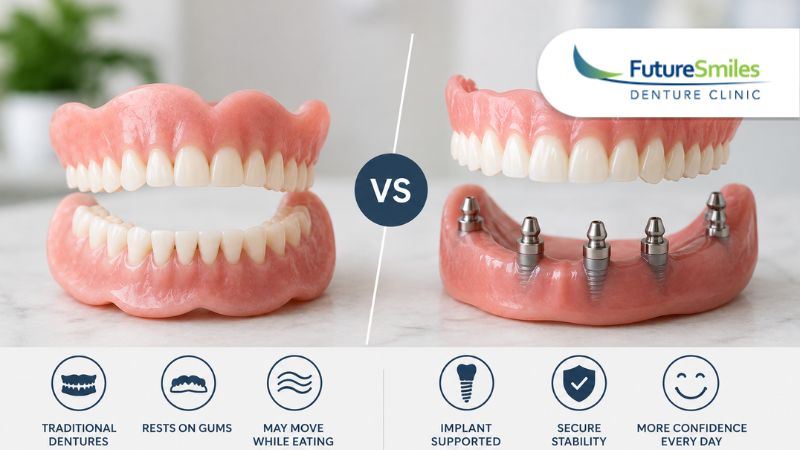
Traditional full dentures are removable appliances designed to replace an entire arch of missing teeth. They rest directly on the gums and rely on their shape, fit, natural suction, and the muscles of the mouth to remain stable.
When properly designed and maintained, traditional dentures can restore appearance, speech, and everyday chewing function. They also offer an important advantage for patients who want to replace missing teeth without undergoing implant surgery.
However, the mouth continues to change after natural teeth are lost. The gums and jawbone gradually reshape, which means a denture that once fit securely may eventually begin to move. Regular adjustments and relines help accommodate these changes and can extend the useful life of the appliance.
Implant-supported dentures use a different method of retention. Dental implants are surgically positioned in the jawbone and provide attachment points for the denture. Instead of relying entirely on the gums for stability, the denture connects to these implants.
The main differences include:
- Support: Traditional dentures rest on the gums, while implant dentures gain additional support from implants.
- Stability: Implant support can reduce movement during eating and speaking.
- Surgery: Traditional dentures do not require implant surgery.
- Treatment time: Implant treatment generally involves a longer process that includes placement and healing.
- Maintenance: Both options require daily cleaning and ongoing professional care.
- Cost: Implant-supported treatment generally involves a greater initial investment.
- Eligibility: Conventional dentures are available to a broader range of patients, while implant treatment requires additional assessment.
Implant-supported dentures can be removable or incorporated into a more fixed restoration, depending on the treatment plan. A removable implant denture can typically be taken out for cleaning but attaches securely when worn.
The additional retention can be particularly useful for the lower arch. Lower traditional dentures have less surface area available for support and must function alongside the tongue and other moving muscles. Some patients therefore experience more movement with a lower denture than an upper denture.
Implant support may help reduce this movement and create a more predictable feeling during everyday activities.
That does not mean every traditional denture should be replaced with an implant-supported one. Many patients are comfortable and function well with conventional dentures for years. The question is whether the benefits of implant support address a specific concern that cannot be adequately managed through conventional denture care.
WHEN IMPLANT SUPPORT MAY HELP
One of the most common reasons patients consider changing from traditional dentures to implant-supported dentures is persistent looseness.
Dentures can become loose as the gums and jawbone change shape. In many situations, this can be corrected through a professional adjustment or denture reline. If the denture itself is old or excessively worn, replacement with a new conventional denture may also restore comfort and stability.
For some patients, however, instability continues to be a concern even with an appropriately fitted denture. This is where implant support may become worth exploring.
Signs that you may want to discuss implant support include:
- Your dentures frequently move while eating
- Your lower denture lifts or shifts when speaking
- You regularly rely on denture adhesive
- You avoid certain foods because of denture movement
- You feel nervous about laughing or speaking in social settings
- Your dentures have been professionally adjusted but stability remains a concern
- You want to explore a more secure tooth replacement option
Eating is one area where greater stability can make a noticeable difference. A traditional denture rests on soft tissue, and movement can occur when pressure is applied unevenly. Connecting a denture to implants provides additional anchorage and can reduce movement during chewing.
Speech can also be affected by denture stability. When a denture shifts during conversation, it may cause clicking or make certain sounds more difficult to pronounce. Reducing movement may help some patients speak with greater confidence.
Another consideration is denture adhesive. Adhesive can be useful for some denture wearers, but increasing reliance on it may be a sign that the appliance should be professionally evaluated. Implant support can reduce reliance on adhesive for certain patients because the denture has dedicated attachment points.
Before assuming implants are necessary, however, the cause of the problem should be identified.
A loose traditional denture may simply need:
- A minor adjustment
- A professional reline
- Bite correction
- Repair
- Replacement because of age or wear
Choosing a more complex treatment when a simpler solution could restore function may not be necessary.
Implant support becomes particularly valuable when a patient wants greater stability and conventional solutions are no longer providing the desired experience. A professional assessment helps separate problems caused by an outdated denture from concerns that may genuinely benefit from implants.
Patients should also consider their expectations. Implant-supported dentures can improve retention, but they are not identical to natural teeth. They still require cleaning, professional maintenance, and appropriate care.
Attachments can wear over time. The denture itself can also require adjustment, repair, or eventual replacement. Understanding these realities before treatment helps patients develop realistic expectations and make informed decisions.
DECIDING WHICH OPTION FITS YOU
Whether implant-supported dentures can replace your traditional dentures depends on several individual factors. The first is whether you are an appropriate candidate for dental implants.
Implants require support from the jawbone. After teeth are lost, bone gradually changes because natural tooth roots are no longer present. The amount and quality of available bone therefore need to be evaluated before implant placement.
Diagnostic imaging may be required to assess the jaw and determine whether implant treatment is possible. Some patients have adequate bone for the proposed treatment, while others may require additional procedures or may be better suited to another option.
Oral and general health are also important. Because implants are surgically placed, your dental professionals need to consider factors that may influence healing or the long-term success of treatment.
Potential candidates often include people who:
- Have lost all or most teeth in an arch
- Currently wear traditional full dentures
- Have persistent denture stability concerns
- Have suitable oral and general health
- Have adequate bone or appropriate treatment options
- Are able to maintain good daily oral hygiene
- Understand that surgery and healing are involved
- Can attend ongoing maintenance appointments
- Have realistic expectations for the final restoration
Lifestyle preferences matter as well. Some people appreciate the simplicity of traditional removable dentures. They may be comfortable with their current level of stability and prefer to avoid surgery.
Others place a higher priority on increased retention and are comfortable with a more involved treatment process.
Cost and timeline also need to be considered. Traditional dentures generally involve a more straightforward treatment process. Implant-supported dentures include implant placement, healing, specialized components, and additional treatment planning, which can increase both the timeline and overall investment.
Patients should consider ongoing costs too. Implant attachments may eventually require replacement, and the denture will continue to experience normal wear. Routine professional assessments remain important regardless of which option is chosen.
Traditional dentures also have several advantages that should not be overlooked:
- No implant surgery is required
- Treatment is generally more straightforward
- They can effectively replace a complete arch
- Adjustments and relines can address many fit changes
- They may be appropriate for patients who do not qualify for implants
- They generally require a lower initial investment than implant treatment
The decision does not always have to be viewed as traditional dentures versus implants forever. Someone may begin with conventional dentures and later decide to investigate implant support if their needs or preferences change.
Likewise, a patient experiencing problems with an existing denture should not assume implants are the only next step. A reline or replacement denture may resolve the issue effectively.
The most useful question is not whether implant-supported dentures are universally better. It is whether they offer meaningful advantages for your particular situation.
A comprehensive assessment can evaluate your existing dentures, gums, jawbone, bite, and concerns. From there, the available options can be compared based on comfort, stability, treatment requirements, maintenance, and long-term goals.
Implant-supported dentures can replace traditional dentures for eligible patients who want additional stability, but conventional dentures remain an effective solution for many people. The right choice depends on why your current dentures are causing concern, the health of your mouth and jaw, and what you hope to achieve from treatment.
At Future Smiles Denture Clinic, we can assess your current dentures and help you understand whether an adjustment, reline, new traditional denture, or implant-supported option may better meet your needs. If you are considering moving from traditional dentures to implant support, contact our team to schedule a consultation and explore your options.
FAQs
Q: CAN EXISTING DENTURES BE CONVERTED TO IMPLANT-SUPPORTED DENTURES?
A: In some situations, an existing denture may be suitable for modification, but this depends on its design, condition, fit, and the planned implant system. Other patients may require a new denture specifically designed to work with implants. A professional assessment is needed to determine which approach is appropriate.
Q: ARE IMPLANT DENTURES MORE STABLE?
A: Implant-supported dentures can provide greater retention because they connect to implants placed in the jaw. This can reduce slipping or lifting during eating and speaking. However, the amount of improvement depends on the individual treatment plan, and implant dentures still require proper fit and ongoing maintenance.
Q: SHOULD I REPLACE LOOSE DENTURES WITH IMPLANTS?
A: Not necessarily. Loose dentures may be caused by natural changes in the gums, normal wear, or an outdated fit. An adjustment, reline, or replacement denture may be enough to restore stability. If conventional solutions do not provide the level of stability you want, implant-supported dentures may then be worth exploring.

.jpg "What Happens During Your Very First Visit to a Denturist?")